 Back
Back
Augmenting the process of sensemaking in design research.
- Context
- Time
- Topics
- University Project
- 2019, 5 months
-
Product Design
- Role
- My role in this project involved everything from planning and conducting research, designing the concept and building the prototypes. The project was carried out as my bachelor's thesis at HfG Schwäbisch Gmünd together with Florian Deitermann and Janis Walser.
Overview
Design at its core is about organizing complexity and finding clarity in chaos. Finding this clarity, meaning making sense out of data, is a crucial aspect for the process of innovation. In our Thesis, we investigated the process of sensemaking in the context of design research in order to find out how this process can be altered.
Grounded in the findings from our research, we developed principles that illustrate important mechanics for the process of sensemaking. Further, we developed a tool, that we call Link — a digital platform for managing, structuring and analyzing large sets of research data, to ultimately develop insights and draw novel meaning from it.
Problem Statement
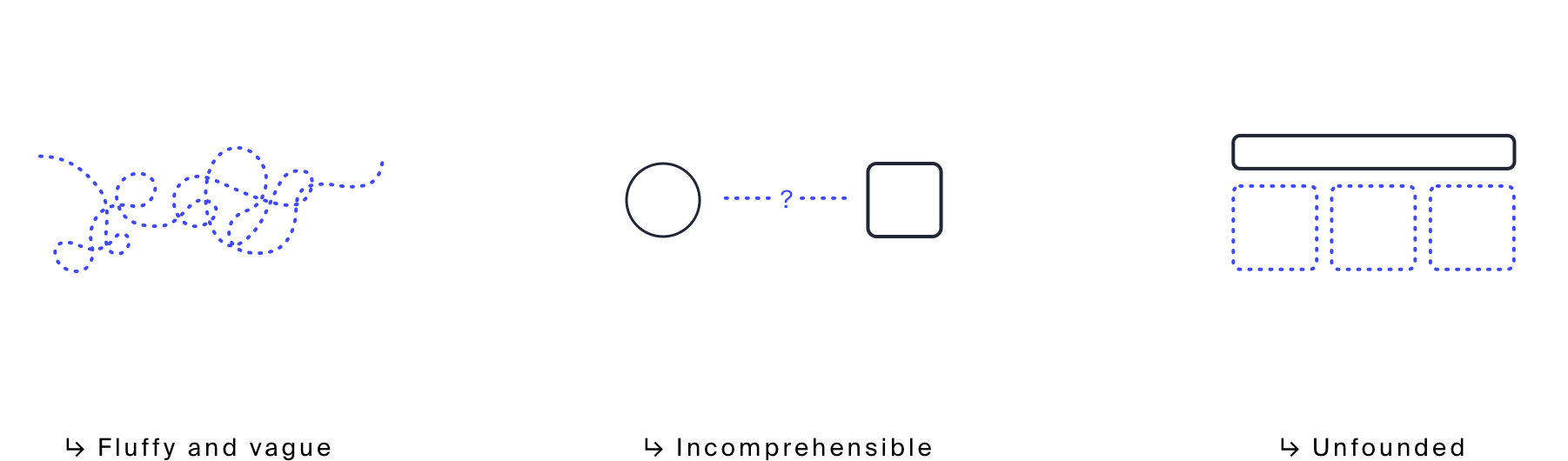
Synthesis is an abductive sensemaking process, which is why Design Research often appears as...
Crucial Aspects of Synthesis
In order to get a better understanding of the discipline and to uncover how we could alter the process of sensemaking, we conducted qualitative interviews with experienced design researchers at Dark Horse, Designit, FJORD, IBM, IDEO, Kaiser X Labs and PCH Innovations.
From that we derived what we call crucial aspects of synthesis, themes that illustrate important principles, mechanics and elements for the process of sensemaking. These aspects would serve us as a foundation for the project and would shape the requirements that we would need to fulfill.
Making thoughts tangible
Externalize
Synthesis is about forcing an external view on data. By making thoughts tangible and transferring them to a physical space, they become part of a shared sensemaking process. The effort of getting thoughts, reflections, and ideas out of our individual minds is called Externalization.
Think with your hands
People’s thoughts, choices and insights can be transformed by physical interaction with things. In the course of problem solving, we naturally tend to recruit artefacts and manipulate them to augment and transform our ability to think and to explain ourselves.
Spatialize
As the team gathers more and more data, each artifact is transferred to a research wall, a physical space where the artifacts are mapped out. By organizing these artifacts in ways that illustrate meaning, the researcher is able to build up a representation of his mental model.
Giving meaning to data
Filter
To avoid cognitive overload, researchers want to move away as fast as possible from raw data. By sorting out redundant information, summarizing and interpreting the data, the researcher is starting to make sense out of the data. This process is referred to as filtering.
Be abductive
Qualitative data alone has little value. Only when this data is interpreted, underlying needs are identified and novel meaning is created, the true value of qualitative research shows. In order to achieve this, the researcher applies abductive logic, to give meaning to data.
Sharing a mental model
Collaborate
While sense making is an internal, personal process, the process of synthesis works best when it’s done external and collaborative. The interaction and collaboration with other team members or stakeholders will uncover different views, spark new discussions and eventually promote inspiration.
Tell a story
When sharing research findings with others — be it with other team members, the client or with other stakeholders — storytelling plays a crucial role in order to be able to evangelize a point of view on the research findings.
Core concepts
Having completed the research phase, and with the principles we’ve developed in mind, we started to put our ideas into concrete terms. We explored concepts that already emerged during research and started ideating on possible solutions. We conducted a Design Sprint and derived the result into four core concepts that build the foundation of Link.
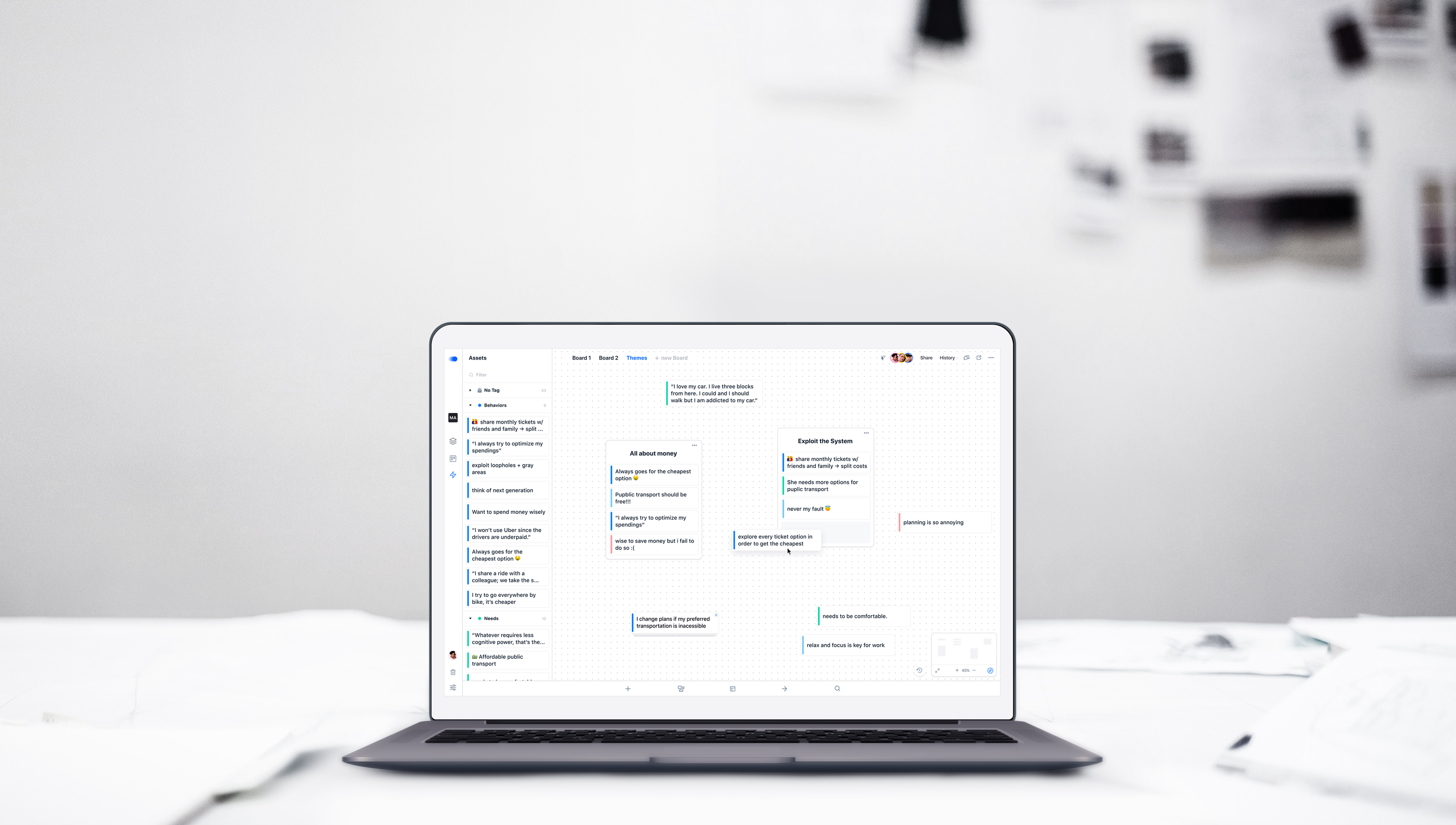
Grounded in the findings from research, derived from the core concepts and inspired by notions of the ideation phase we developed a digital application that we call Link — a platform for managing, structuring analyzing research data and to subsequently develop better insights.

A place for unifying research artifacts
To quickly externalize thoughts, observations or findings during a debrief session, one can create a data asset by using the data asset input field.
A framework for data analysis
In Link, teams can gather, organize and manage all kinds of data, be it qualitative, quantitative or data from secondary research.
A playground for collective sensemaking
Starting to make sense out of all constituents, the team can use the Canvas to start building a spatial representation of their mental model.